
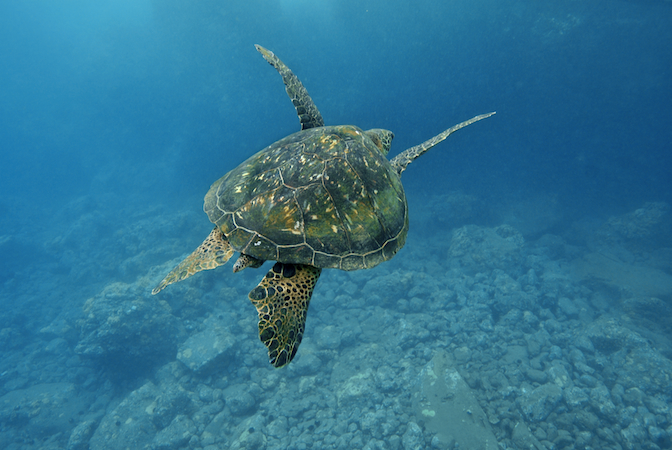
Sea Turtle Migration
Most sea turtles migrate between foraging and nesting grounds, and seasonally to warmer waters. Often these migrations take them hundreds and even thousands of miles. With satellite telemetry, scientists can track the movements of sea turtles between areas and even across entire oceans.
Sea turtles nest in tropical and subtropical regions around the globe. Both males and females will migrate to nesting areas to breed, generally in the area where they were born. It is not known exactly how adult turtles are able to navigate to their natal (birth) beaches, however, researchers think they may use a number of clues including ocean currents, the earth's magnetic field, and water chemistry.
Sea Turtle Migration Facts
Leatherback sea turtles are among the most highly migratory animals on earth, traveling as many as 10,000 miles or more each year between foraging grounds in search of jellyfish. In the Atlantic, they go from Caribbean beaches up the US East Coast to Canada. In the Pacific, many go from Southeast Asia (Indonesia and Malaysia) to California and then up to Alaskan waters.
Loggerheads born in Japan migrate almost 8,000 miles to the rich waters off Baja California, Mexico to feed and mature. Once they have reached sexual maturity, they migrate back to Japan to breed and nest.
The leatherback has a lightly pink spot on the top of its head directly above their brain. It is thought that this allows light to reach the pineal gland which may be used for migration. The pineal gland is an endocrine gland found in vertebrates which affects wake/sleep patterns and functions to signal day length. This combined with a change in temperature can signal a change in day length and season which indicates migration time.
In February 2020, a sea turtle named Yoshi was tracked from Australia to the waters of Angola on Africa’s eastern coast and back. a record trip of 22,000
What is SEE Turtles?
We're a nonprofit organization that protects sea turtles through conservation travel and volunteer tours, our Billion Baby Turtles, Too Rare To Wear, & Sea Turtles & Plastic programs, our education programs, and by promoting inclusivity in the sea turtle community. Our award-winning programs help save sea turtle hatchlings on important nesting beaches around the world, work with the tourism industry to end the turtleshell trade, and get plastic out of sea turtle habitats. Learn more about our organization.
Photo credits: Neil Ever Osborne, Tui DeRoy