Guarding Hope on the South Coast: The Sea Turtle Conservation Story of Kompak Jolosutro Lestari
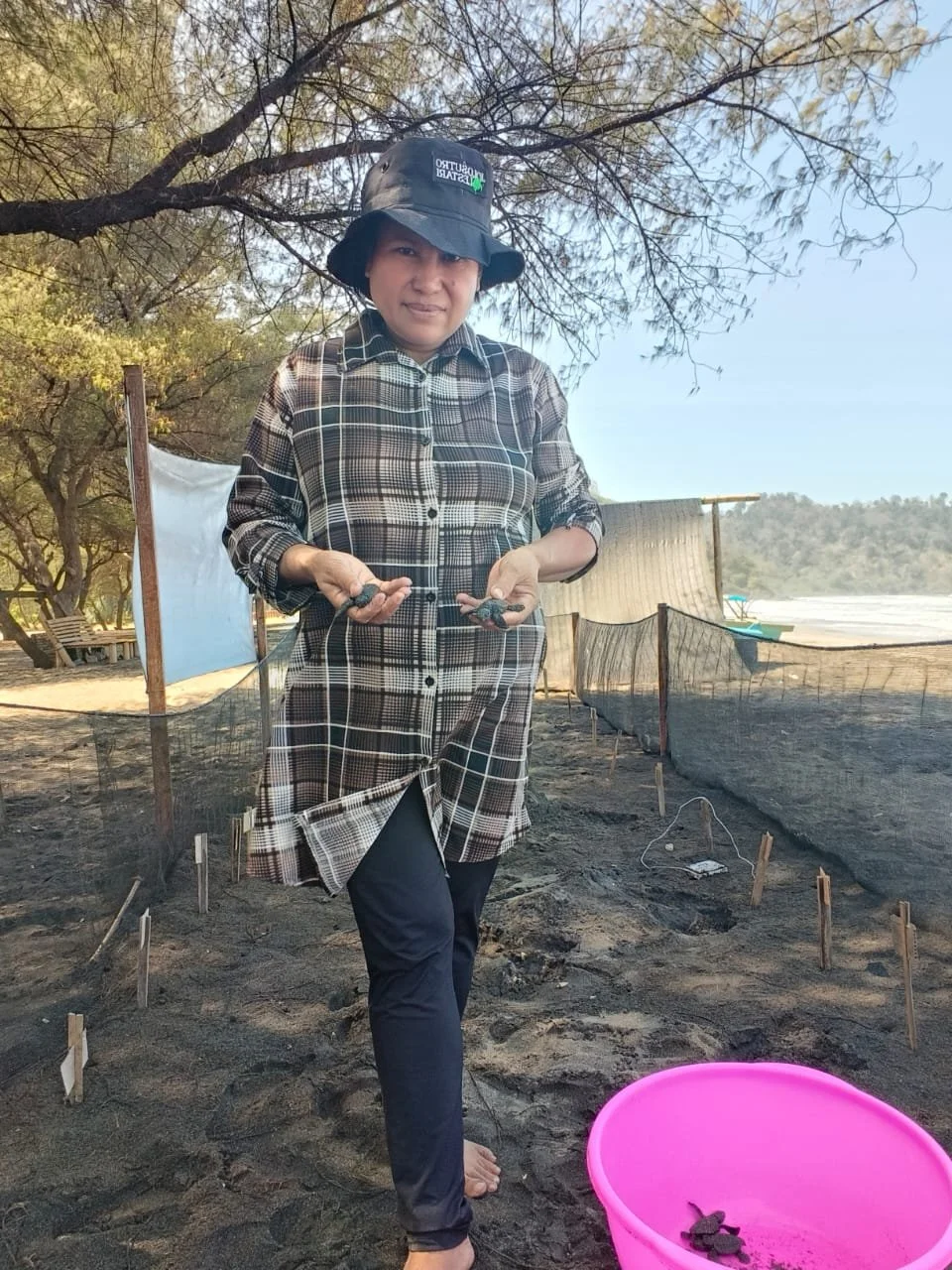
My name is Yuke Wiji Lestari, a sea turtle conservation activist born and raised on the coast of Jolosutro Beach, Ringinrejo Village, Wates District, Blitar Regency, East Java. This beach is a crucial natural habitat for various rare and protected sea turtle species, such as olive ridley, green, hawksbill, and leatherback turtles.
After years of working overseas as a migrant worker, I returned to my hometown in 2019 and found a very concerning situation. The sea turtle population had drastically declined due to egg theft, illegal hunting for meat, habitat destruction caused by coastal erosion and tidal floods, as well as the catching of clear lobsters using light traps that disrupt the turtles' natural navigation when landing. This situation awakened my moral calling as a native daughter to take real action to save these ancient animals that are increasingly threatened with extinction.
With the full support of my husband, Sugito, a traditional fisherman, and our extended family, we initiated conservation steps independently. We evacuated sea turtle eggs from vulnerable nests and moved them to makeshift semi-natural nests near our home so they could be monitored 24 hours a day. The biggest challenge actually came from our own social environment, where some of the perpetrators of the exploitation were neighbors and even relatives who depended on marine products.
Realizing that a repressive approach would not solve the problem, I chose the path of humanitarian dialogue. Using my personal savings from working abroad, I provided compensation to residents who were willing to hand over sea turtle eggs to be saved. Slowly but surely, we built the community's trust. As a grassroots movement led by women, we build conservation through increasing awareness and strengthening the sense of belonging to the environment, without the need for confrontation.
This self-reliant struggle with limited resources yielded extraordinary results. For over five years, we have successfully saved more than 8,000 sea turtle eggs and released around 6,000 hatchlings into the sea, with a hatching success rate reaching 80 percent. This consistency at the grassroots level gained widespread attention, which encouraged us to legalize this movement. In 2024, we processed the legality, and in 2025, we were officially recognized by the Indonesian government under the name Jolosutro Lestari Community Conservation Movement Group, which I lead to this day.
Our mission at Kompak Jolosutro Lestari is to protect endangered sea turtles and restore coastal ecosystems through a community-based approach. We integrate environmental conservation, education, and local economic empowerment, emphasizing the involvement of traditional fishermen, women, and the younger generation. An important moment for our group occurred when we collaborated with the Human Initiative, Trust, and Ocean (HITO Project) and received support from the Telkom Sustainability CSR program. Through this partnership, we successfully built Eco-Tury (Ecological Tukik Hatchery), a modern semi-natural hatching facility designed to protect sea turtle eggs from predators and environmental risks, while supporting educational activities. As of May 2026, thanks to this facility and community participation, we have protected more than 40 new nests with a total of around 4,000 sea turtle eggs this nesting season.
Social change is now tangible. Residents who used to resist are now proud and directly involved in saving the animals. However, we realize that the challenges of climate change and ecosystem degradation are becoming more complex. Therefore, in addition to saving sea turtle eggs, we are actively rehabilitating coastal ecosystems by planting coastal vegetation such as sea pine and sea pandanus to curb the rate of coastal erosion and tidal floods.
Through future projects and initiatives, we want to strengthen this community-based conservation system. We plan to expand educational facilities, improve the scientific monitoring system for sea turtles, and develop sustainable ecotourism that provides direct economic benefits to local communities. Our long-term vision is to make Jolosutro Beach a community-based sea turtle conservation and eco-learning center that can serve as a pilot model for other coastal areas in Southeast Asia.
For us, preserving sea turtles is a form of moral and spiritual responsibility. We believe that investing in local communities and providing alternative livelihoods are the most effective ways to protect marine ecosystems. Every saved nest, every hatchling that touches the waves, and every resident involved is a symbol of hope for a future of a more harmonious relationship between humans and nature.