
Leatherback Sea Turtles
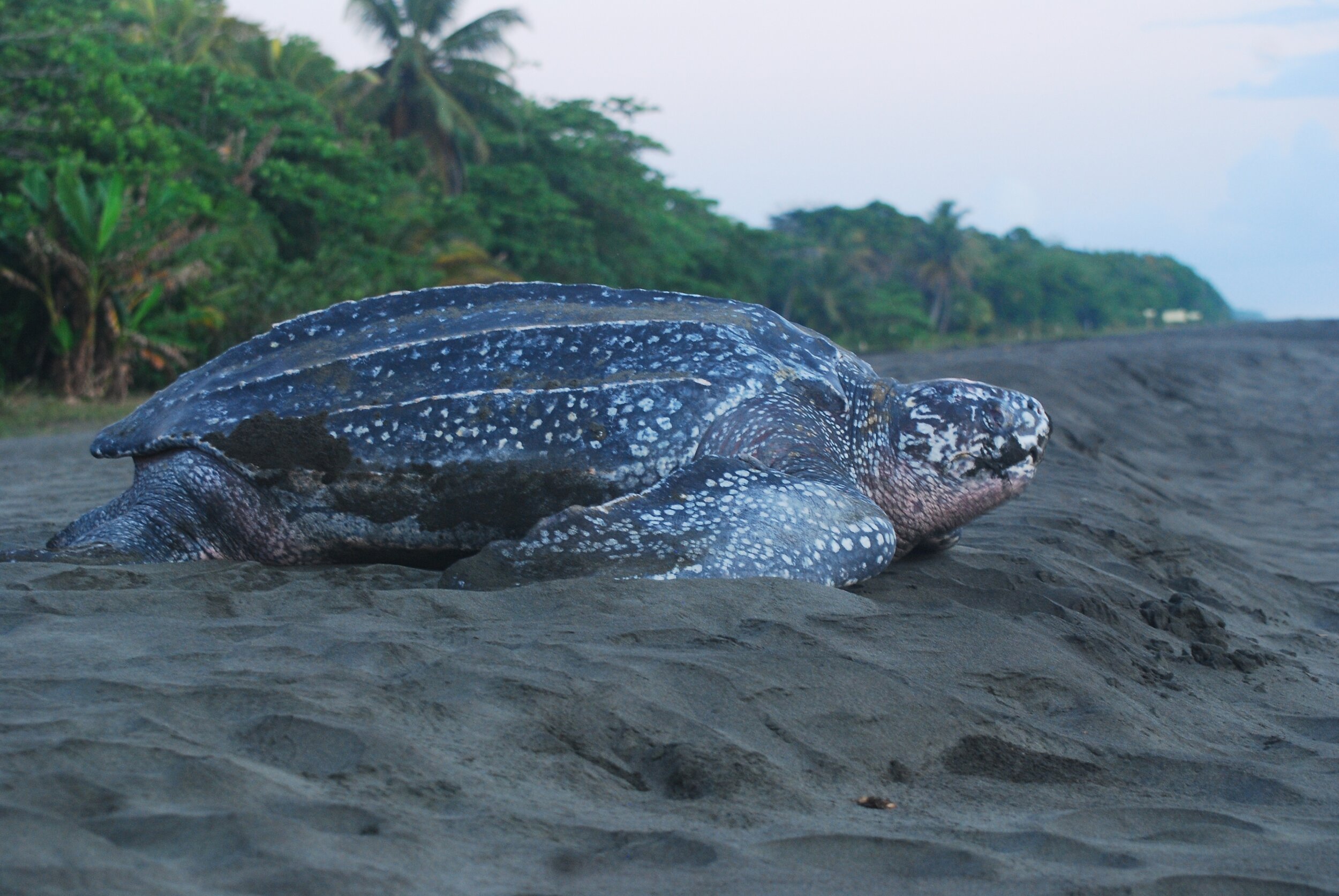
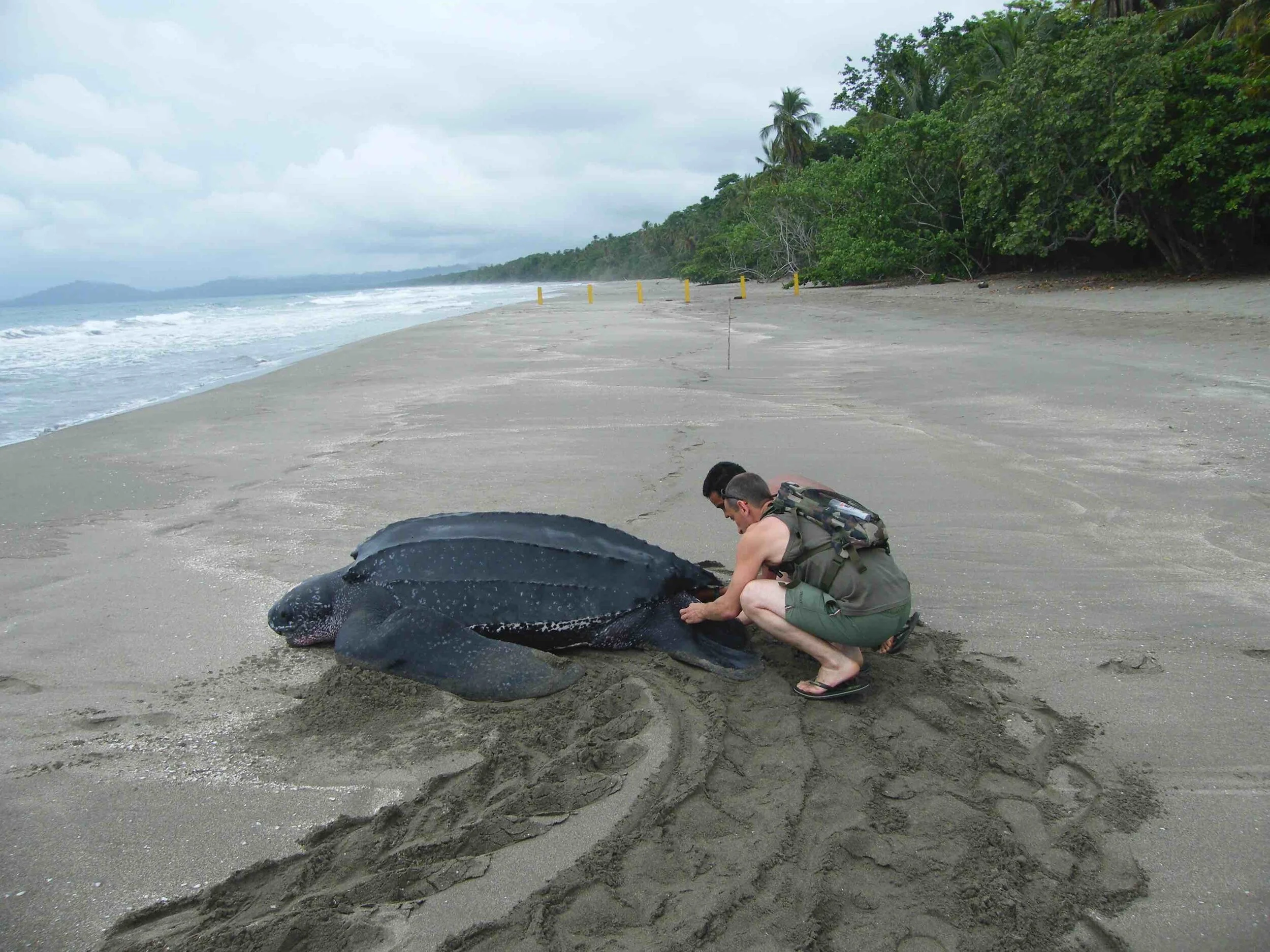
The largest of all sea turtles, and one of the largest reptiles on earth, the leatherback turtle ranges in size from 4-8 feet in length (1.2 - 2.4 meters) and weighs between 500-2,000 pounds (225 - 900 kg). The average adult measures in between 5-6 feet (1.5 - 1.8 m) and weighs 600-800 pounds (270 - 360 kg).
The oldest of all sea turtle species, it has been around for more than 150 million years! They survived the extinction of the dinosaurs and thrived until the last several decades when human interactions have taken a major toll.
Leatherback Turtle Facts & Tidbits
Leatherbacks can consume nearly their own body weight in prey per day (about 73% of their weight), feeding exclusively on soft-bodied invertebrates like jellyfish and tunicates. Learn more about their diet.
They have downward curving spines (also known as papillae) in their mouth and throat which help them to capture and swallow their prey.
Unlike all other sea turtles, these giants do not possess a carapace (shell) covered with hard scales, also known as scutes. Their smooth, leathery skin covers a flexible matrix of bone. This specialized, flexible carapace allows them to dive to great depths unlike other species.
Their widespread distribution and ability to tolerate cold water are due to thermoregulatory adaptations (called gigantothermy) which allow them to maintain their core body temperature.
They are considered Vulnerable around the world by the IUCN Red List and listed as Endangered in the US.
Their scientific name is Dermochelys coriacea.
Distribution
Leatherbacks have the widest distribution of all sea turtle species. They are found throughout the Pacific, Atlantic, and Indian Oceans. In the Pacific, their range extends as far north as Alaska and south beyond the southernmost tip of New Zealand.
In the Atlantic, they can be found as far north as Norway and the Arctic Circle and south to the tip of Africa. They are mainly pelagic (open ocean) wanderers but migrate to tropical and subtropical coastal regions to mate and nest.
Major Threats
The Pacific population has declined by over 90% in the last two decades due primarily to entanglement in commercial fishing gear, particularly longlines and gillnets. Their eggs are also consumed in many parts of the world.
These ancient creatures are also vulnerable to ingestion of floating marine debris like discarded plastics. Plastic bags and balloons resemble their favorite prey, jellyfish, and when ingested may block their digestive tract, preventing them from eating.
Did You Know?
The largest one on record washed up dead on the coast of Wales (UK) in 1988. It weighed over 2,000 lbs and measured 9 feet in length! It was estimated to be approximately 100 years old. The turtle had been drowned from entanglement in fishing gear.
They can dive deeper than 4,000 ft (roughly 1,200 m)! Sperm Whales, Beaked Whales, and Elephant seals are the only other known animals that dive deeper.
Researchers recently tracked an adult female more than 12,000 miles (19,000 km) using satellite telemetry, from Indonesia to Oregon, one of the longest recorded migrations of any vertebrate animal. Read an article about this incredible journey.

What is SEE Turtles?
We're a nonprofit organization that protects sea turtles through conservation travel and volunteer tours, our Billion Baby Turtles, Too Rare To Wear, & Sea Turtles & Plastic programs, our education programs, and by promoting inclusivity in the sea turtle community. Our award-winning programs help save sea turtle hatchlings on important nesting beaches around the world, work with the tourism industry to end the turtleshell trade, and get plastic out of sea turtle habitats. Learn more about our organization.
Photo credits: Neil Ever Osborne